

 français
 русский
 español
 العربية
Search
What Are You Looking For?
Search

The global telecommunications infrastructure spans millions of towers—ubiquitous, connected, and positioned at strategic heights. For decades, these structures served a single purpose: carrying antennas for voice and data. Today, a quiet transformation is underway. Communication towers are being reimagined as multi-purpose ecological observatories, hosting infrared cameras, acoustic sensors, avian radar, and environmental monitors that track everything from migrating birds to forest fires. This convergence of connectivity and conservation—dubbed “one tower, multiple uses”—represents a paradigm shift in both network economics and environmental science.
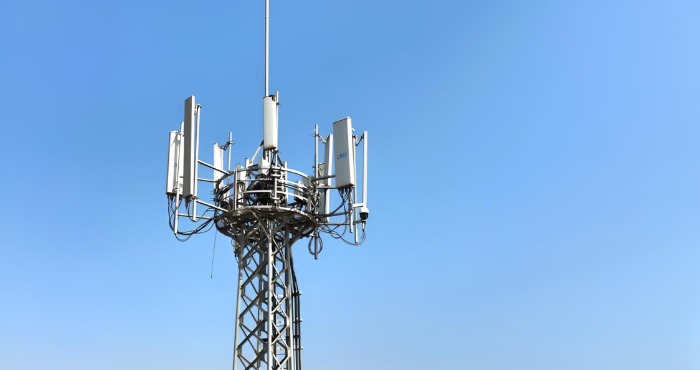
The fundamental challenge of wildlife monitoring is achieving spatial coverage without human disturbance. Traditional methods—ground observers with binoculars, camera traps placed at random intervals—are labor-intensive, spatially limited, and inevitably intrusive. Animals alter their behavior when humans approach; researchers cannot be everywhere at once.
Communication towers solve all three constraints simultaneously. They offer:
· Elevated vantage points: From 15 to 100 meters above ground, tower-mounted cameras see what ground-level sensors miss
· Ubiquitous presence: 12.6 million communication towers exist globally; China alone has over 2 million
· Existing infrastructure: Power, connectivity, security, and maintenance crews already in place
· Non-intrusive observation: Cameras mounted at height remain unnoticed by wildlife below
The economic logic is equally compelling. Adding monitoring equipment to an existing tower costs a fraction of building a dedicated observation post. The incremental cost is limited to sensors and installation; the platform—the tower itself—is already amortized.
Modern ecological monitoring towers deploy a layered array of technologies, each addressing a specific observational need.
High-definition cameras and infrared thermal imagers form the visual backbone of tower-based monitoring. Thermal cameras detect minute temperature differences—as little as 0.1°C—enabling night-time observation of warm-blooded animals and, crucially, detection of human intruders engaged in illegal hunting. Single thermal cameras can cover a radius of up to 3 kilometers, transforming a single tower into a wide-area surveillance node. In coastal applications, high-resolution optical systems integrated with zoom lenses can identify individual bird species at distances exceeding 1,000 meters.
Not all wildlife can be seen. In dense forests, marshy wetlands, or nocturnal environments, acoustic sensors become primary detection tools. Bioacoustic monitoring systems record ambient sound continuously, while AI algorithms identify species-specific calls. This technology is particularly valuable for bird surveys in foggy or densely vegetated habitats where visual identification is impossible, as well as for amphibian population assessments during breeding seasons when vocal activity peaks, and for bat activity monitoring using ultrasonic detectors sensitive to frequencies above human hearing.
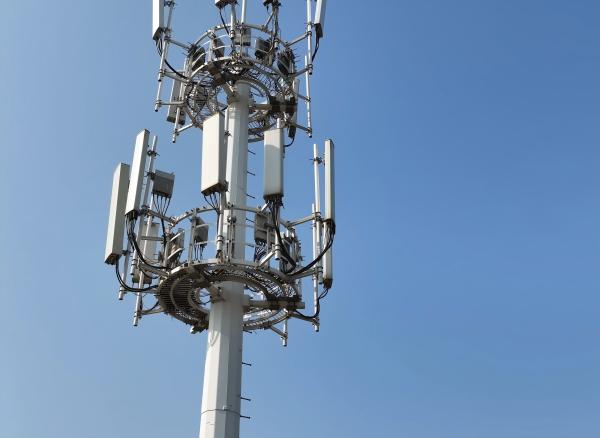
Radar systems adapted from air traffic control and wind energy applications provide real-time detection and tracking of airborne wildlife. Avian radar can detect birds and bats at ranges of 3 to 8 miles, providing data on altitude, flight path, flock size, and speed. The technology was originally developed for the US Air Force to reduce bird-aircraft strike risk and has since been adapted for wind farm siting and ecological research.
Automated radio telemetry networks such as the Motus Wildlife Tracking System consist of fixed receiving stations that detect signals from tiny radio transmitters attached to birds, bats, and even butterflies. These receivers record the unique ID of any tagged animal passing within range—typically 9 to 15 kilometers—building continent-scale migration maps through the aggregation of data from hundreds of collaborating towers. Every tower that joins this network becomes a node in a global scientific infrastructure.
Complementing wildlife-specific sensors, towers also host instruments for habitat monitoring: air quality and particulate sensors, soil moisture probes (where tower bases penetrate the ground), water level gauges and temperature loggers for adjacent wetlands, and microclimate stations measuring wind speed, humidity, and solar radiation. These environmental parameters provide critical context—animal behavior is meaningless without understanding the conditions that drive it.
Integration strategies fall into three categories, each suited to different contexts.
The most cost-effective approach. Existing towers—whether lattice structures or monopoles—accept additional brackets and mounting points for cameras and sensors. Power and network connectivity are already present. This approach is ideal for broad-area monitoring across existing infrastructure footprints, as well as for projects where rapid deployment is prioritized over customization.
The Chinese telecom tower industry has pioneered this model at remarkable scale. China Tower Corporation has retrofitted thousands of its existing communication towers with ecological monitoring payloads, leveraging its nationwide inventory. In Jiangsu Province alone, 242 towers have been converted into “digital ecological towers,” monitoring species from migratory birds to Yangtze finless porpoises.
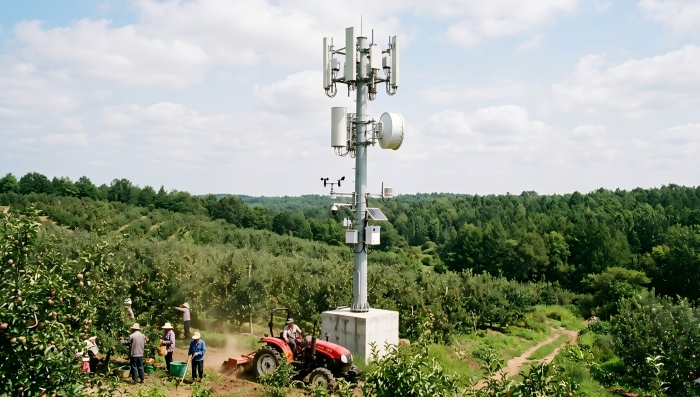
In protected areas where existing towers are absent or where aesthetic impact is a primary concern, purpose-built camouflage towers—designed as artificial trees or integrated into existing structures—host monitoring equipment while preserving visual harmony.
A Chinese utility model patent describes an “outdoor camouflage-type wildlife monitoring apparatus” consisting of a tree-mimicking body equipped with cameras, pressure sensors, audible alarms, and motorized elevation controls. The apparatus not only conceals its observation function but also includes protective mechanisms to prevent curious animals from damaging the equipment.
For point-specific monitoring—such as tracking a particular nesting site or water source—small, self-contained sensor nodes can be attached to towers or nearby structures. The Nature 4.0 project has demonstrated an integrated networked sensor system that treats plants and animals not merely as targets of investigation but as parts of a modular sensor network that carries sensors on the animals themselves.
Jiangsu Province represents the most advanced large-scale integration of ecological monitoring into telecom infrastructure. Working with provincial authorities, China Tower has transformed 242 communication towers into “digital ecological towers” across wetlands, coastal zones, and nature reserves. Each tower hosts a layered sensor suite: high-definition infrared cameras capable of day-night operation; avian AI recognition systems automatically identifying 421 bird species including red-crowned cranes and oriental storks; and environmental sensors monitoring water quality, vegetation health, and microclimate.
The system’s impact has been measurable across multiple dimensions. It has enabled species-specific tracking—the tower-mounted high-resolution cameras automatically captured footage of a mother finless porpoise swimming with her calf, a behavior previously documented only through chance sightings. It has supported law enforcement—thermal cameras detected illegal poachers, leading to arrests. And it has provided population data—continuous monitoring revealed that the reserve’s bird population had reached 25,759 individuals, documenting steady growth.
Along the Yangtze River, tower-mounted AI cameras have accumulated 50 records of finless porpoise activity within a single year, identifying distinct individuals including a mother-calf pair. The same system increased illegal fishing detection rates by 65% while reducing response time to an average of 42 minutes.
Yunnan Province is home to nearly 793 bird species—63.7% of China’s total. Working with forestry authorities and the Chinese Academy of Sciences, China Tower has deployed an AI-driven monitoring network across nature reserves including Yuanjiang, Tongbiguan, and Dashanbao.
The system has achieved species-level recognition: a deep learning model trained on tens of thousands of images can distinguish seven hornbill species with high accuracy, tracking their movement in real time. It has enabled acoustic monitoring: AI-based sound recognition detects species such as the wreathed hornbill in dense forest where visual observation is nearly impossible. And it has supported emergency response: thermal imaging and smoke detection algorithms have reduced forest fire warning times to under five minutes. When a precipitous drop in the population of glossy ibises triggered an AI alarm, authorities traced the cause to upstream pesticide pollution and shut it down.
The Zhuonai Lake Protection Station in the heart of the Hoh Xil (Kekexili) region—the “Tibetan antelope maternity ward”—received 5G coverage through a collaboration between China Mobile, ZTE, and China Tower in July 2023. The base station operates at an altitude of 4,800 meters, powered by solar energy, designed for 11-level winds and -50°C temperatures. It uses 700MHz band for 10-kilometer coverage radius, 2.6GHz band for 32 simultaneous HD video uploads, and microwave backhaul spanning 57 kilometers. The network enables real-time observation of Tibetan antelope births and ensures that protection staff are never isolated.
The Ouabache Land Conservancy is installing a Motus Wildlife Tracking System tower at Atherton Island Natural Area along the Wabash River. The tower will fill a critical data gap in the existing Motus network—a global collaborative of automated radio telemetry stations that track migratory birds, bats, and insects. The project demonstrates how a single tower, thoughtfully sited with access to internet and electricity, becomes part of a continent-wide research infrastructure.
Successfully adding ecological monitoring payloads to communication towers imposes specific engineering requirements.
The transformation of communication towers into wildlife monitoring platforms generates dual returns.



 IPv6 network supported