
 français
 русский
 español
 العربية
Search
What Are You Looking For?
Search

In the competitive landscape of telecommunication and power transmission infrastructure, the upfront engineering design of an angle steel tower is often celebrated for its structural elegance and load-bearing efficiency. However, the true determinant of project profitability and timeline success lies not only in what is designed but in how it is built. A design that looks perfect on paper can harbor prohibitive hidden costs in fabrication, logistics, and field assembly. This is where Design for Manufacturing and Installation (DFMI)—a proactive, holistic engineering philosophy—becomes the critical lever for cutting total project cost and mitigating risk.

DFMI moves beyond pure structural calculation to integrate the constraints and opportunities of the entaily chain: shop fabrication, transportation, and field erection. Its core principle is simple: optimize the design for the entire lifecycle from workshop to commissioning, thereby eliminating waste, reducing complexity, and accelerating deployment.
Before applying DFMI, it's crucial to identify where costs and delays typically hide:
Fabrication Complexity: Excessive unique part numbers, non-standard connection details, and intricate welding requirements drive up shop labor hours, increase material handling, and elevate the risk of error.
Logistical Inefficiency: Components designed without regard to standard trucking dimensions, weight limits, or container sizes lead to costly oversized shipments, complex securing schemes, and multiple trips.
Installation Bottlenecks: Designs that are difficult to sequence, align, or bolt together on-site—especially under challenging weather or in remote locations—result in prolonged crane rentals, higher labor costs, and significant schedule overruns.
DFMI systematically attacks these areas through three pillars: Standardization, Modularization, and Installation-Centric Detailing.
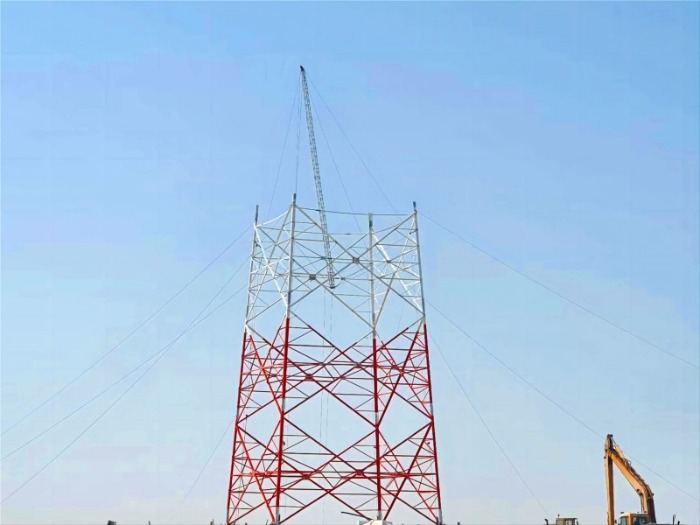
The goal is to reduce variation and simplify the bill of materials (BOM).
Standardized Connection Nodes: Instead of customizing each bolted joint, DFMI employs a library of pre-engineered, pre-calculated connection types (e.g., standard gusset plate details for specific force ranges). This allows for:
Batch production of identical components.
Use of jigs and fixtures for faster, more accurate assembly.
Reduced engineering and drafting time for repetitive elements.
Minimized Part Proliferation: By rationalizing member lengths and cross-sections, the number of unique part codes can be drastically reduced. This simplifies procurement, inventory management, and quality control in the factory.
Design for Automated Processes: Details are tailored for efficient CNC punching/drilling and hot-dip galvanizing. This includes ensuring adequate hole clearances for galvanizing drainage, avoiding trapped air pockets, and designing for easy dipping and handling.
Here, design is governed by the logistics corridor from factory to site.
Transportation Geometry: The maximum dimensions and weight of any shipping module are dictated by standard flatbed trailer or container specifications. DFMI breaks down the tower into the largest possible modules that still comply with these limits, minimizing the number of shipments and crane lifts.
Pre-Assembled Submodules: Where possible, smaller components are permanently joined in the controlled factory environment to form larger, rigid submodules (e.g., complete bracing panels, leg sections with pre-attached ladders). This shifts labor from the challenging field environment to the efficient shop floor, drastically cutting on-site assembly time.
Integrated Lifting and Rigging Points: Lifting lugs or pick points are designed into major modules. Their location is calculated to ensure balanced, stable lifts, and they are fabricated as an integral part of the component, eliminating the need for unsafe and time-consuming field-attached slings.
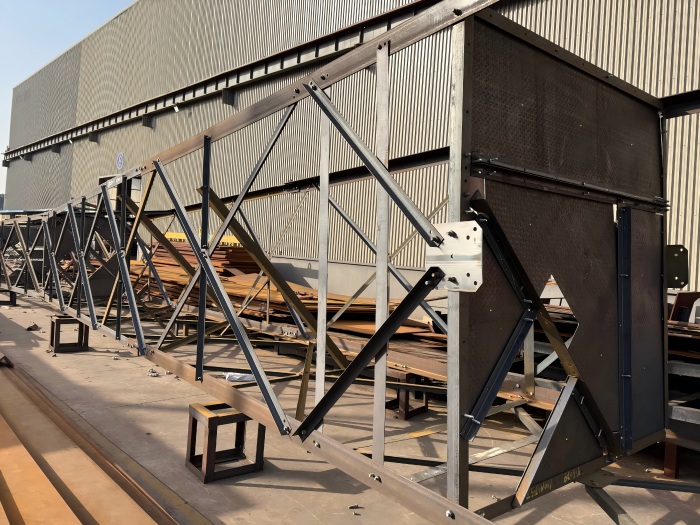
The design actively enables fast, safe, and error-proof field assembly.
Bolted Connections Over Welding: While not always possible, prioritizing bolted connections for major field splices is a cornerstone of DFMI. This requires precision in hole alignment, achieved through match-marking and the use of drill jigs during fabrication. It eliminates the need for highly skilled field welders, expensive welding equipment, and time-consuming non-destructive testing (NDT) on-site.
Self-Guiding and Self-Supporting Features: Components are detailed to fit together in only one correct way. This can include tapered spigots for leg alignment, unique bolt patterns to prevent incorrect assembly, and temporary connection points for torsional bracing during the erection sequence.
Sequential Erection Clarity: The DFMI process produces clear assembly sequence drawings that guide the erection crew. The design itself facilitates this sequence, ensuring stability at every intermediate stage without requiring excessive temporary supports.
Implementing a rigorous DFMI approach yields measurable benefits across the project lifecycle:
Reduced Fabrication Cost: Lower labor hours, less material waste, and higher workshop throughput.
Predictable Logistics: Fewer shipments, lower freight costs, and simplified customs documentation for international projects.
Accelerated Installation: Site work can be reduced by 30-50%, minimizing weather exposure and rental costs for heavy equipment.
Enhanced Quality & Safety: Controlled factory production ensures higher, more consistent quality. Ergonomic and safer installation sequences reduce on-site risks.
Lower Total Cost of Ownership (TCO): While DFMI may require slightly more upfront engineering investment, the savings across fabrication, logistics, and installation overwhelmingly deliver a superior project ROI.

For angle steel tower projects, DFMI is not a luxury but a necessity for remaining competitive and profitable. It represents a shift in mindset—from the engineer as a pure analyst to the engineer as an integrator of the entire value chain. By designing with the fabricator's workshop, the truck driver's route, and the erection crew's wrench in mind, we move beyond creating merely adequate structures to delivering optimized assets where efficiency, cost, and reliability are engineered in from the very first sketch. In an industry where margins are tight and schedules tighter, DFMI is the definitive strategy for cutting the hidden costs that traditional design leaves on the table.
Learn more at www.alttower.com



 IPv6 network supported