

 français
 русский
 español
 العربية
Search
What Are You Looking For?
Search

The wind energy industry is engaged in a quiet but relentless race upward. A decade ago, a 70-meter wind turbine was considered substantial. Today, 100-meter hub heights are standard, and turbines reaching 150 meters and beyond are increasingly common. For developers planning multi-million dollar wind farms, the stakes are enormous: a 10% error in wind speed assessment can translate to 30% variance in energy production estimates—and millions in revenue uncertainty. The foundation of accurate wind resource assessment is the meteorological (met) tower, which must rise to at least the hub height of the proposed turbines. As turbines climb, so must the towers that measure the wind. In this pursuit of height, the guyed lattice tower has emerged as the undisputed industry standard.
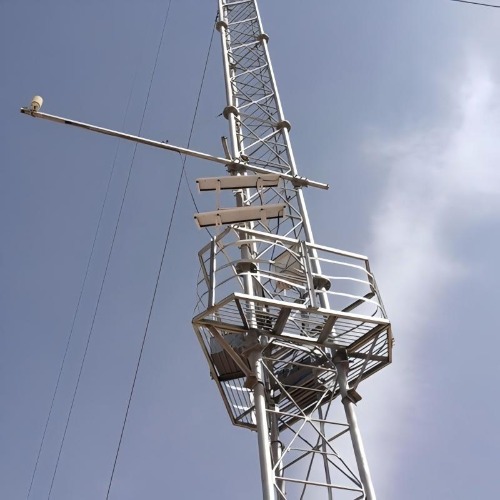
Wind speed increases with elevation—a phenomenon known as wind shear. But this relationship is not linear or universal. It varies by terrain, atmospheric stability, and local geography. To accurately predict energy production, developers must measure wind speed at the actual height where turbines will operate.
Modern utility-scale turbines routinely feature hub heights of 100 to 160 meters. Offshore turbines and next-generation onshore models push toward 200 meters. A met tower that measures only at 60 or 80 meters forces developers to extrapolate wind speeds upward using theoretical models—models that can introduce unacceptable uncertainty into multi-million dollar investment decisions.
The industry standard, therefore, has become 100-meter met towers for onshore wind development, with taller structures specified for projects with higher hub heights or complex terrain.
Reaching 100 meters with a self-supporting structure is possible but economically punishing. A self-supporting lattice tower at this height requires substantial steel in its base sections—the cubic relationship between height and material demand drives costs exponentially upward. Foundations become massive concrete blocks or deep pile systems designed to resist enormous overturning moments.
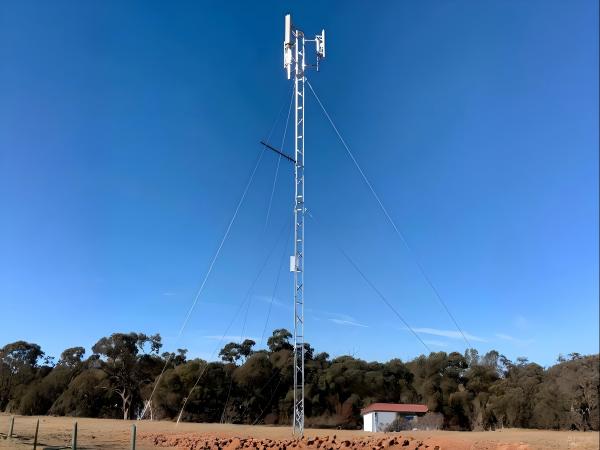
The guyed tower solves this problem through a fundamental shift in structural behavior. Instead of resisting wind forces through the tower's own bending strength, it transfers lateral loads into tension in the guy cables and compression in the slender mast. This separation of function allows the mast to be remarkably lightweight—a uniform cross-section rather than a dramatically tapered base.
For a 100-meter tower:
Self-supporting lattice: Requires substantial steel in base sections, often 50-80 tons total.
Guyed lattice: A slender mast with 3-4 levels of guy cables, total steel weight often 15-25 tons—a 50-70% reduction.
This material efficiency translates directly to fabrication, transportation, and installation savings.
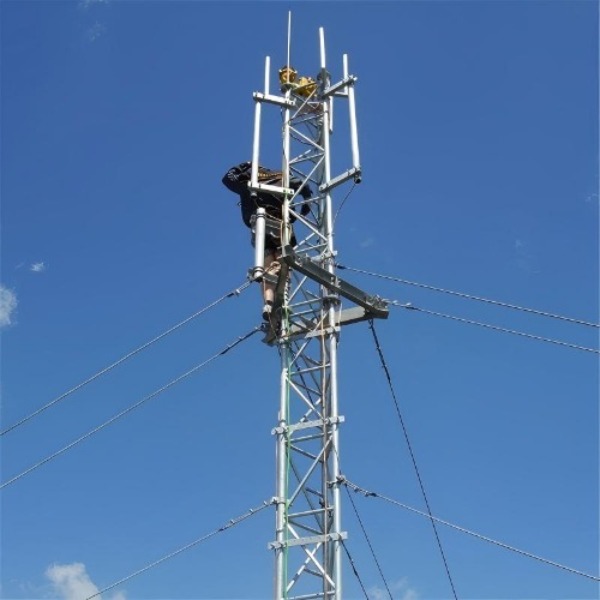
Beyond raw material economy, guyed towers offer specific advantages for met tower applications.
1. Minimal Flow Distortion
Wind measurement requires the sensing equipment to be placed in undisturbed airflow. A self-supporting tower, with its substantial cross-section and massive base, can create wake effects that distort readings from anemometers mounted on the structure. The slender profile of a guyed mast minimizes this flow interference, providing cleaner, more accurate data.
2. Adaptable Siting in Complex Terrain
Wind farms are often located in precisely the areas where self-supporting towers are hardest to erect: ridgelines, steep slopes, remote forested areas. Guyed towers, with their modular components and ability to be erected with smaller cranes or even helicopter assistance, adapt readily to challenging sites.
3. Lower Foundation Impact
The central foundation of a guyed tower carries primarily compression from the mast's weight. Three or four anchor foundations, spaced radially, resist cable tension. This distributed system requires less concrete volume and can often be installed with minimal earth disturbance—a significant advantage in environmentally sensitive areas or on rocky terrain where excavating a single massive foundation is impractical.
4. Reduced Visual Impact
For temporary measurement campaigns (typically 1-3 years), the visual footprint matters. A slender guyed tower is far less intrusive than a massive self-supporting structure, easing permitting in areas with aesthetic concerns.
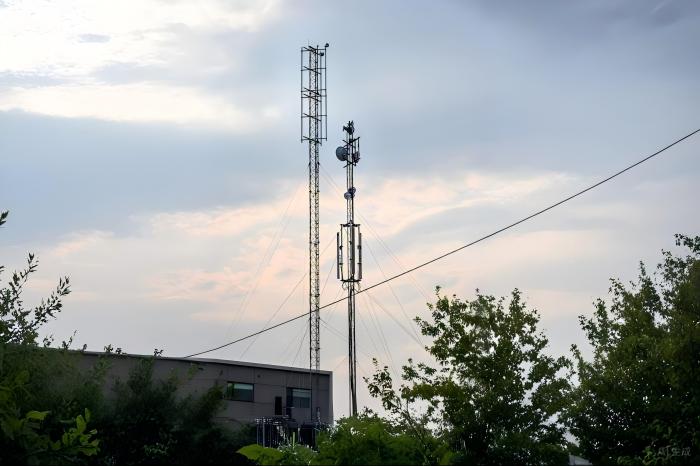
The economic advantage of guyed towers at 100+ meters is decisive:
| Height | Self-Supporting Cost | Guyed Tower Cost | Ratio |
|---|---|---|---|
| 60m | Baseline | Baseline | 1:1 |
| 80m | 2.0x | 1.4x | 1.4:1 |
| 100m | 3.5x | 1.8x | 1.9:1 |
| 120m | 5.5x | 2.2x | 2.5:1 |
(These ratios are illustrative; actual figures vary by location and design specifications.)
The cost differential widens with height because the self-supporting tower's material and foundation requirements escalate exponentially, while the guyed tower's cost increases at a rate much closer to linear.
A typical wind measurement campaign follows a predictable pattern that aligns perfectly with guyed tower capabilities:
· Site Selection: The tower must be positioned in the zone of intended turbine development, often on ridgelines or open terrain where self-supporting tower foundations would be most challenging.
· Permitting: Guyed towers, with their lower visual impact and reduced foundation footprint, often secure approvals more quickly, especially in areas with scenic or agricultural protections.
· Installation: The modular design allows for erection with smaller cranes. A 100-meter guyed tower can be installed in 3-5 days with a crew of 4-6, compared to 2-3 weeks for a self-supporting structure.
· Measurement Period: Typically 12-24 months of continuous data collection, with anemometers mounted at multiple heights (often 40m, 60m, 80m, 100m, and sometimes 120m). Guyed towers accommodate instrument booms with minimal flow distortion.
· Decommissioning: Once the wind farm is financed and construction begins, the met tower is removed. Guyed towers disassemble efficiently, leaving behind only the small anchor foundations, which can be removed or left with minimal land impact.



 IPv6 network supported