

 français
 русский
 español
 العربية
Search
What Are You Looking For?
Search

Radar support towers and telecom towers look similar from a distance—both are steel structures that elevate equipment above the ground. But beneath the surface, they are fundamentally different engineering systems. Telecom towers are designed for signal coverage—they carry passive antennas and are optimized for height, capacity, and cost. Radar towers are designed for data fidelity—they support rotating, precision-sensing equipment and are optimized for stiffness, low vibration, and precise pointing accuracy. While a telecom tower's primary metric is coverage, a radar tower's ultimate performance metric is data fidelity. This difference drives every aspect of their design: from the loads they carry to the vibration tolerances they must meet to the platforms and access systems they integrate.
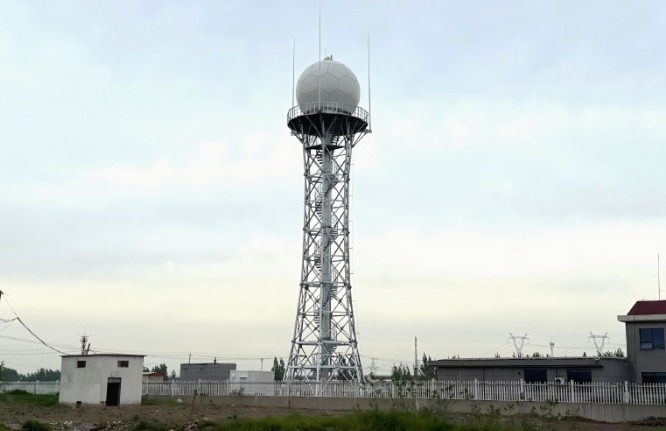
· Equipment is fundamentally different: Telecom towers carry static, passive antennas. Radar towers support heavy, rotating, precision-sensing equipment that demands micron-level pointing accuracy.
· Load profiles diverge sharply: Telecom loads are relatively light and distributed. Radar loads are concentrated, heavy (radomes can weigh 3,400 kg), and dynamic—the rotating antenna creates cyclic loads that telecom towers never experience.
· Stability and vibration requirements are orders of magnitude apart: Telecom towers tolerate moderate deflection and vibration. Radar towers require natural frequencies above 1 Hz (often ≥3 Hz) to avoid resonant coupling with the rotating antenna—a performance metric driven by physics, not preference.
· Platform requirements are different: Telecom platforms are simple antenna mounting rings. Radar platforms are stiffened diaphragms that must contribute positively to tower rigidity while supporting heavy equipment and personnel loads.
· Maintenance access must not compromise stiffness: Every ladder rung, platform bracket, and cable guide on a radar tower alters the structure's dynamic behavior—access systems must be embedded into the structural logic from the outset.
Who is searching for this information?
| User Type | Primary Intent | Key Concerns |
|---|---|---|
| Radar system engineers | Specify support structures for new radar installations | Structural performance criteria, vibration tolerances, standards compliance |
| Telecom infrastructure managers | Evaluate whether existing telecom towers can host radar equipment | Load capacity, stiffness adequacy, modification feasibility |
| Procurement / project managers | Compare vendor proposals for radar vs. telecom tower projects | Cost drivers, design complexity, lead times |
| Engineering students / researchers | Understand the fundamental differences in tower design philosophy | Structural mechanics, dynamic analysis, load cases |
Search intent summary: Users want to understand why radar towers cost more and take longer to design than telecom towers—and what specific engineering parameters drive that difference. This is often a pre-procurement question:"Can I use a telecom tower for my radar, or do I need a purpose-designed radar tower?"
1. Can a telecom tower be repurposed to support a radar? What are the limiting factors?
2. What is the weight difference between telecom antennas and radar equipment?
3. Why is natural frequency so critical for radar towers? What happens if it's too low?
4. How does the rotating antenna affect tower design?
5. What platform loads must a radar tower support?
6. How do maintenance access systems affect radar tower stiffness?
7. What standards govern radar tower design vs. telecom tower design?
8. What is the typical height and cost difference between the two tower types?
9. Can radar towers be camouflaged like telecom towers?
10. What vibration limits apply to radar tower design?
Why radar towers prioritize data fidelity while telecom towers prioritize coverage.
Comparison of what the two tower types actually support.
How equipment weight and movement drive structural design.
Why natural frequency is the defining metric for radar towers.
How platform design differs between the two tower types.
Integrating climbing systems into radar towers without degrading stiffness.
Real-world examples of radar tower engineering.
Answers to the most common questions.
The distinction between radar and telecom towers begins with purpose. A telecom tower exists to provide signal coverage—it elevates antennas to a height where radio signals can reach users across a geographic area. A radar tower exists to support precision sensing—it elevates a rotating antenna to a height where it can detect, track, and characterize objects with high accuracy.
This purpose difference cascades into every engineering decision. "Unlike communication towers that simply hoist passive antennas, radar towers must provide an exceptionally stable platform for rotating, precision-sensing equipment. A slight structural deflection, an unexpected vibration mode, or—just as critically—an access component that introduces unwanted flexibility can compromise the radar's pointing accuracy".
Telecom Towers: Passive, Distributed, Static
Telecom towers carry antennas that are passive—they do not rotate, they do not require precise pointing, and they generate no dynamic loads of their own. A typical 5G antenna weighs 40–47 kg, and a full sector might total 200–300 kg. These loads are distributed across platforms at various heights and are essentially static from a structural perspective. The tower does not need to maintain the antenna's orientation with any particular precision—a fraction of a degree of antenna movement has negligible impact on coverage.
Radar Towers: Active, Concentrated, Dynamic
Radar towers support equipment that is fundamentally different:
· Rotating antennas: Weather surveillance radars, air traffic control radars, and many defense radars rotate continuously. The antenna's rotational frequency (typically 0.1–0.5 Hz for weather radars) creates a cyclic load that the tower must accommodate without resonant amplification.
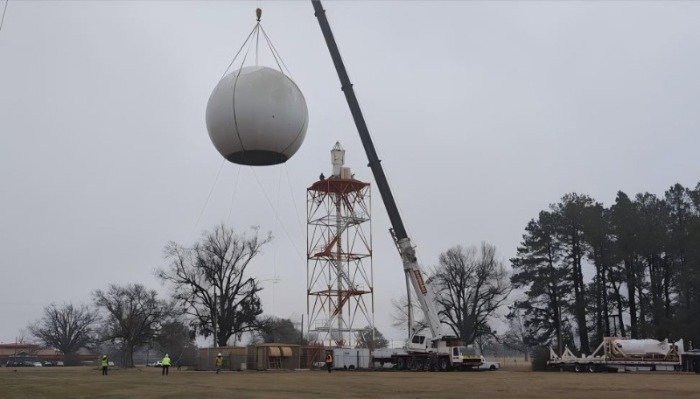
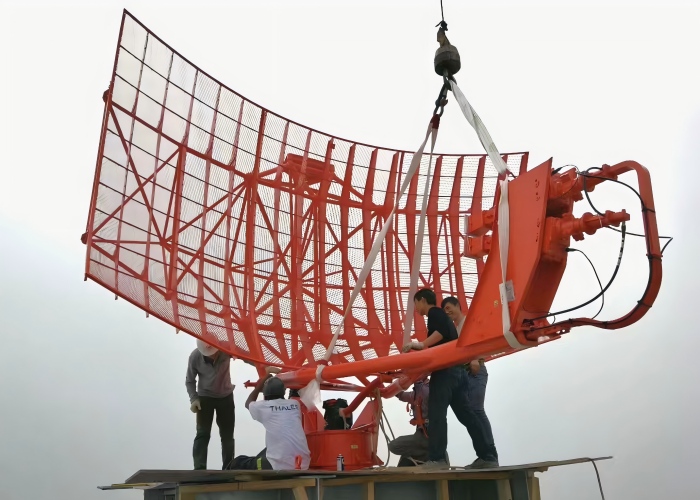
· Heavy radomes: A radome protecting a radar antenna can weigh 3,400 kg—comparable to the entire antenna load of a small telecom tower.
· Precision pointing requirements: The antenna's pointing direction must be known and stable to within fractions of a degree. This demands a tower with exceptional stiffness and minimal deflection under all load conditions.
· Concentrated loads: Unlike the distributed loads of telecom antennas, radar equipment is concentrated at specific elevations—the antenna and radome at the top, processing equipment at intermediate platforms.
Telecom Loads: Light, Distributed, Predictable
Telecom tower design loads are dominated by environmental forces—wind and ice—rather than equipment weight. The equipment itself contributes relatively little to the structural demand. A typical 60-meter telecom tower might support a total equipment load of 1,000–2,000 kg, distributed across multiple platforms.
Radar Loads: Heavy, Concentrated, Dynamic
Radar towers must handle a load profile that is more demanding in every dimension:
| Load Type | Telecom Tower | Radar Tower |
|---|---|---|
| Equipment weight | 1,000–2,000 kg (distributed) | 3,000–10,000+ kg (concentrated) |
| Dynamic loads | Negligible | Cyclic from rotating antenna |
| Pointing precision demand | Low (coverage tolerant) | Extreme (fractions of a degree) |
| Ice accumulation | Standard | Critical—radomes and antenna surfaces collect ice |
The concentrated weight of radar equipment—particularly the radome and antenna assembly—creates large bending moments at the tower top. The tower must be designed not just to carry this weight, but to carry it without deflection that would degrade pointing accuracy.
This is the most fundamental technical difference between the two tower types.
Telecom Towers: Moderate Stiffness Requirements
Telecom towers must be stiff enough to prevent excessive deflection under wind loads—typically limited to a few degrees at the top. But there is no requirement to avoid specific vibration frequencies. A telecom tower can vibrate at any frequency without affecting its function, as long as the movement doesn’t exceed structural limits.
Radar Towers: Natural Frequency as a Design Driver
Radar towers are governed by an entirely different set of dynamic requirements. The tower's natural frequency must be kept sufficiently high and well-separated from the forcing frequencies generated by the rotating antenna and environmental wind loads to avoid resonant coupling that would smear radar images.
The physics are unforgiving. Every structure has inherent natural frequencies at which it preferentially vibrates. If the frequency of a forcing function—such as the antenna's rotational frequency or vortex shedding from wind—coincides with the tower's natural frequency, energy builds up, resulting in amplified vibrations. For a radar tower, this resonant coupling can cause the antenna to vibrate persistently, distorting the radar image and rendering data unreliable.
The solution is to design the tower's natural frequency significantly higher than the dominant forcing frequencies. Industry practice requires:
Natural frequency ≥ 1 Hz for weather radar towers—a requirement driven by the need to avoid the antenna's rotational frequency and its harmonics
Natural frequency ≥ 3 Hz for some precision radar applications—requiring even greater structural stiffness
Separation margin of at least 1.5× between the tower's natural frequency and the forcing frequencies
Achieving these frequencies requires maximizing structural stiffness—because for heavy radar antennas and radomes, reducing mass is often impractical. The tower must be engineered not just to carry weight, but to resist deformation under dynamic loads with exceptional rigidity.
Telecom Platforms: Simple Antenna Mounting Rings
Telecom tower platforms are relatively simple structures—typically steel rings or brackets that provide mounting points for antennas and RRUs. They are designed for equipment access and wind load distribution, but they do not need to contribute to tower stiffness.
Radar Platforms: Stiffened Diaphragms
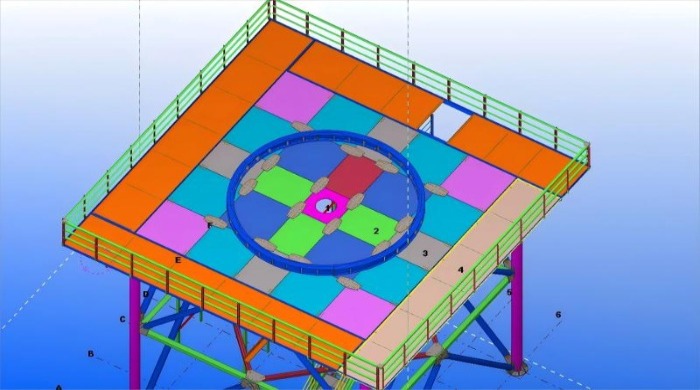
Radar tower platforms serve a dual function: they provide work areas for maintenance personnel and mounting points for equipment, and they contribute to the tower's overall structural rigidity.
"From a structural perspective, platforms should be integrated as stiffened diaphragms—their floor beams and bracing must contribute positively to the tower's overall rigidity". Key design principles include:
Full-perimeter bracing: Platforms should be tied into all tower faces with cross-bracing or stiffened decking to act as horizontal stiffening rings, preventing local mode shapes that could reduce natural frequencies
Load transfer: Platform loads must be transferred into tower legs via dedicated connection nodes, not through diagonal bracing alone
Open steel grating: Preferred over solid plate because it reduces wind load accumulation, improves visual inspection of members below, and sheds ice more readily
Typical radar tower platform loads include:
Radome: 140 kN
Antenna: 85 kN
Platform equipment: 8 kN/m²
Live load: 200 kg/m² minimum
Telecom Towers: Access is a Convenience
Telecom tower access systems—ladders, climbing pegs, safety cables—are designed for occasional maintenance visits. They are important for safety but do not affect tower function. Their mass and stiffness contribution is negligible relative to the tower's structural requirements.
Radar Towers: Access Must Not Compromise Stiffness
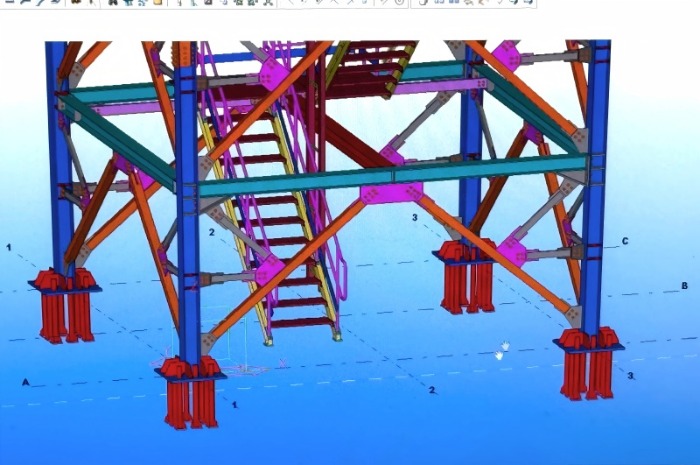
On a radar tower, every access component—every ladder rung, every platform support bracket, every cable guide—alters the structure's mass and stiffness distribution. "Poorly designed access features can introduce local flexibility or add mass in locations that lower critical natural frequencies".
The design challenge is to integrate access systems into the tower's primary structural logic rather than treating them as afterthoughts. Key requirements include:
· Vertical cable fall-arrest systems: The industry standard for radar towers, providing continuous attachment without requiring the user to disconnect at intermediate points. Ladder cages are being phased out with a 2036 deadline for replacement because they do not arrest vertical falls and complicate rescue.
· Platforms as rescue staging areas: Required resting points on tall ladders, typically every 9–12 meters, where a worker can rest or await assistance.
· Lightning protection integration: All metallic access components must be bonded to the grounding system to prevent dangerous side-flashes.
· Structural integration: Access systems must be designed as part of the primary structure—their mass and stiffness contributions included in the dynamic analysis from the beginning.
| Parameter | Telecom Tower | Radar Tower |
|---|---|---|
| Primary performance metric | Signal coverage | Data fidelity |
| Equipment type | Passive antennas | Rotating, precision-sensing equipment |
| Equipment weight | 1,000–2,000 kg (distributed) | 3,000–10,000+ kg (concentrated) |
| Dynamic loads | Negligible | Cyclic from rotation |
| Natural frequency requirement | Not specified | ≥ 1 Hz (often ≥ 3 Hz) |
| Deflection limit | Few degrees | Fractions of a degree |
| Platform function | Antenna mounting only | Structural stiffening + equipment support |
| Access system impact | Negligible | Must be integrated into structural logic |
| Design standard | TIA-222-H | TIA-222-H + radar-specific requirements |
| Height range | 15–80 m (typical) | 15–100+ m |
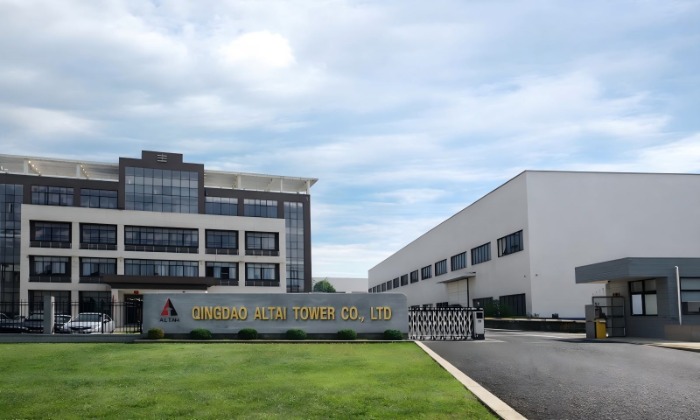
Qingdao Altai Tower Co., Ltd. is a professional manufacturer of telecommunication towers, power towers, and tower accessories, established in 2003. The company specializes in the design, manufacturing, and installation of steel towers, with products exported to more than 100 countries and regions. Its radar support tower product line demonstrates the engineering principles discussed in this blog.
| Capability | Specification |
|---|---|
| Radar tower height range | 15–50 m+ (custom heights available) |
| Design standards | ANSI/TIA-222-H/F/G, BS8100, Euro Part 1&3 |
| Design wind speed | 100–350 km/h (3-second gust) |
| Production capacity | 3,000 metric tons per month |
| Galvanizing | In-house workshop, strictly following ASTM A123 |
| Certifications | ISO 9001, ISO 14001, ISO 45001, CE |
Qingdao Altai Tower supplied a 30-meter radar support tower for pest migration monitoring in China, completed in March 2026. This project demonstrates the application of radar tower design principles to a non-traditional monitoring application—tracking insect migration to support agricultural health.
The tower was engineered with:
· High-stiffness lattice configuration to ensure stable antenna pointing for precise monitoring
· Hot-dip galvanized construction per ASTM A123 for long-term corrosion protection
· Integrated platform design supporting both the radar antenna and monitoring equipment
· Safe climbing access with fall-arrest systems compliant with modern safety standards
For radar tower projects, Qingdao Altai Tower integrates access systems, platform stiffening, and structural design from the outset—ensuring that the tower’s dynamic characteristics meet the demanding requirements of precision radar applications.
The difference between radar support towers and telecom towers is not cosmetic—it is fundamental. Radar towers are precision instruments disguised as steel structures. Every design decision—from material selection to platform detailing to access system integration—is driven by the need to maintain pointing accuracy and data fidelity under dynamic loads.
For project engineers and procurement managers, understanding these differences is essential. A telecom tower cannot simply be "upgraded" to support a radar. A radar tower must be designed from first principles—with natural frequency targets, deflection limits, and dynamic load cases that have no equivalent in the telecom world.
The reward for this engineering rigor is a structure that performs its mission silently and precisely for decades. Radar towers are the unsung enablers of air traffic control, weather forecasting, and defense surveillance—and they earn that role through engineering discipline that goes far beyond what a telecom tower will ever require.
Ready to specify a radar support tower for your precision sensing application? Contact Qingdao Altai Tower's engineering team today for custom design, dynamic analysis, and a detailed proposal.



 IPv6 network supported