

 français
 русский
 español
 العربية
Search
What Are You Looking For?
Search

The camouflage tree tower represents one of the most sophisticated challenges in telecommunications infrastructure: creating a structure that simultaneously disappears from human sight while remaining fully functional for radio signals. This requires navigating a fundamental engineering tension between electromagnetic performance and mechanical robustness.
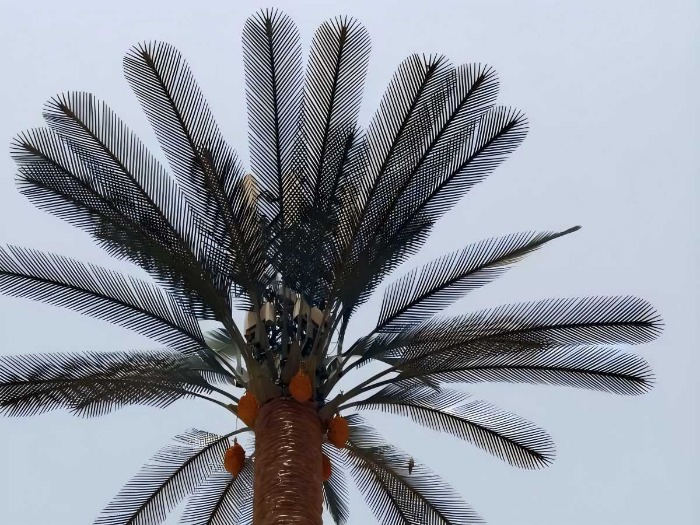
A camouflage tower must satisfy two diametrically opposed requirements:
| Requirement | Implication | Challenge |
|---|---|---|
| RF Transparency | Materials must allow radio waves to pass without attenuation or distortion | Requires low dielectric constants, minimal conductive elements, thin cross-sections |
| Structural Integrity | Must withstand wind, ice, seismic loads for decades | Requires dense materials, robust connections, substantial cross-sections |
The engineer's task is to reconcile these within a structure that convincingly mimics a living tree.
Fiber-Reinforced Polymer (FRP) and High-Density Polyethylene (HDPE) have emerged as the industry standards for camouflage elements because they uniquely bridge this divide:
· Dielectric properties: FRP (ε_r 3.5-4.5) and HDPE (ε_r 2.3-2.5) allow signal passage with minimal loss
· Non-conductive: No metallic content means no parasitic antenna effects
· Structural capability: Glass fibers provide strength without conductivity (unlike carbon fiber)
· UV resistance: Modern formulations survive decades of sun exposure
Manufacturers specify 95-99% RF transparency, meaning signal loss through foliage and bark is kept to 1-5% of original power—imperceptible to network performance.
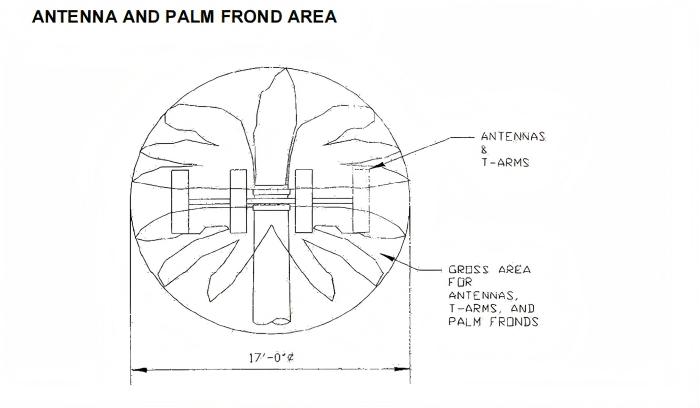
Each branch represents a structural weak point that must transfer wind loads to the core tower without failing. Engineers solve this through:
· Reinforced mechanical connections: Branches attach to protruding receptors on the monopole via both mechanical fasteners and adhesives
· Load-testing: Designs are validated for winds exceeding 80 mph (130 km/h) , with premium ratings up to 250 km/h for typhoon zones
· Ice load accommodation: Branches must survive radial ice accumulation without becoming brittle
The steel monopole core is inherently RF-opaque—it cannot be made transparent. Therefore, antennas must be positioned outside the trunk, within the branch canopy:
· Strategic density: Branch spacing must balance concealment (requires density) against wind load and cost (sparsity)
· Vertical tiering: Multiple antenna arrays require corresponding branch arrangements at each height
This geometry is the fundamental insight: the camouflage conceals the antennas, not the tower itself. The opaque steel remains hidden behind the visual distraction of branches.
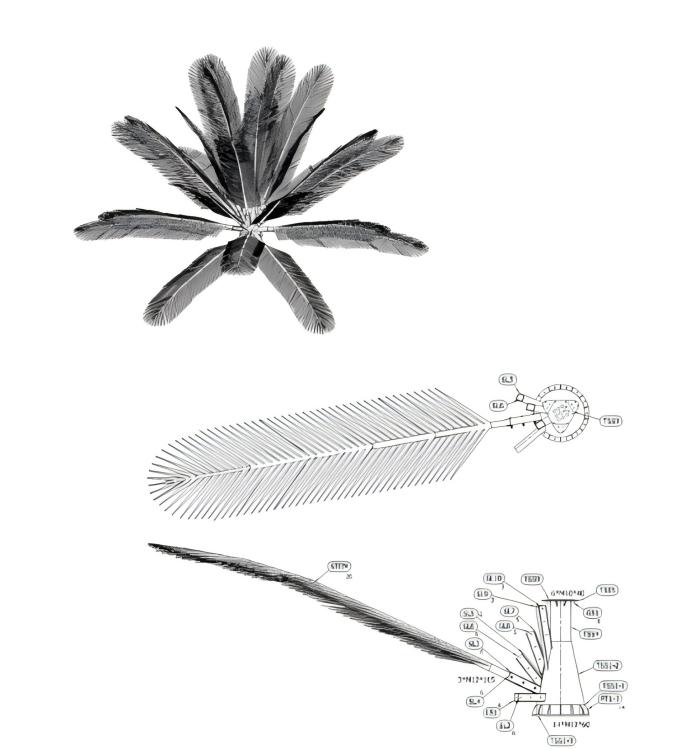
The camouflage system must survive the same environmental loads as the tower it conceals:
Wind: Branches engineered to flex without failing, shedding energy rather than resisting it
Ice: Material flexibility (especially HDPE) helps shed accumulations before critical loads develop
UV: Stabilizers and inhibitors in the polymer matrix prevent embrittlement and fading over decades
Fire: Materials meet Class A or Class 1 ratings, self-extinguishing without contributing to flame spread
The bark-like coating—applied over galvanized steel—is a multi-layer system with embedded texture from real tree molds, finished with UV-resistant topcoats rated for 20-30 year service life.
| Element | RF Requirement | Structural Solution |
|---|---|---|
| Branches | Non-conductive polymer | HDPE/FRP with UV stabilizers, engineered attachments |
| Bark | No conductive pigments | Multi-layer epoxy/polyurethane over steel |
| Core Tower | Opaque—must be avoided | Antennas positioned at branch level, not inside trunk |
| Attachments | Non-conductive where possible | Polymer brackets or shielded steel |
The camouflage tree tower is not a compromise between RF transparency and structural integrity—it is an optimization. By selecting inherently suitable materials, positioning antennas intelligently, and engineering attachments for extreme loads, manufacturers create structures that satisfy both requirements simultaneously. The result is infrastructure that truly disappears: invisible to observers, transparent to signals, and impervious to the elements.
Learn more at www.alttower.com



 IPv6 network supported