
Communication Tower Manufacturer

Industry News

Home News Center Industry News

"DT4DI White Paper 4.0" Released: Creating Business Value for Operators through AI

"DT4DI White Paper 4.0" Released: Creating Business Value for Operators through AI
July 06, 2026

In the telecommunications sector, AI is transitioning from proof-of-concept and localized pilots into the critical phase of large-scale commercial deployment; however, while leading global operators continue to ramp up AI investment, they have yet to realize commercial value commensurate with that investment. Successfully implementing large-scale AI deployment and translating AI investment into tangible business value has become a pressing challenge for the global telecommunications industry.
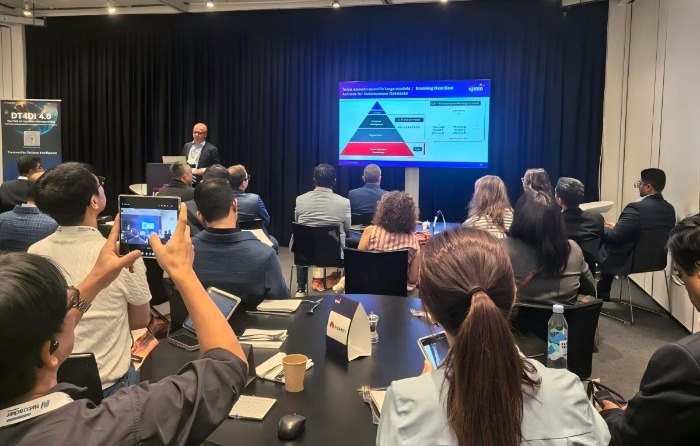


The *DT4DI White Paper 4.0* notes that without a profound understanding of network structures, underlying mechanisms, and operational states, large models struggle to gain trust in critical production processes. To address this industry bottleneck, the white paper outlines three AI application approaches identified by the industry, identifying the third approach as the inevitable choice for handling complex tasks such as achieving AN L4+ (Autonomous Network Level 4 or higher) capabilities:

  1. Approach 1: "Large Language Model (LLM) + Retrieval-Augmented Generation (RAG)." This is limited to retrieving static information and generating text-based explanations; it cannot generate executable optimization commands to form a closed-loop business process, serving primarily as an information query tool.
  2.  
  3. Approach 2: "Large Language Model + Tool Use." While this represents a technical architectural upgrade, underlying execution still relies on legacy tools; its primary function is to optimize operational workflows and enhance human efficiency.
  4.  
  5. Approach 3: "Large Language Model + Digital Twin Network (DTN) + Telecom Domain-Specific Large Model." This approach aligns closely with architectural standards for advanced autonomous networks. Unlike LLMs, which focus primarily on interaction, DTNs and telecom domain-specific large models can determine the "Next Best Action" for optimization within the domain. Taking the SRCON 2.0 (Communication Network Reality Simulation 2.0) domain-specific large model as an example, this model reshapes the network optimization paradigm by leveraging comprehensive data collection and processing from intelligent wireless network elements, alongside domain-specific sub-models based on the Transformer architecture—specifically, the User Experience Diagnosis Large Model (UELM) and the Beam-Space Twin Large Model (BSLM). The UELM analyzes comprehensive wireless network data to autonomously identify experience issues and diagnose root causes within the wireless network, while the BSLM automatically simulates and generates global optimization schemes, deploying them to the network to achieve immediate closed-loop resolution. Thus, Digital Twin Networks and telecom domain-specific large models serve as the core engines of a trustworthy AI foundation.

Leave A Message

Leave A Message
If you are interested in our products and want to know more details,please leave a message here,we will reply you as soon as we can.
Submit

Home

Products

whatsapp

contact