

 français
 русский
 español
 العربية
Search
What Are You Looking For?
Search

A radar tower platform requires a highly specific allocation of space to ensure personnel safety, equipment access, and structural integrity. While exact dimensions depend on the specific radar system, general engineering standards dictate that platforms must provide a clear walkway of at least 0.9 to 1.2 meters around the radome or antenna. Additionally, the platform must support concentrated live loads of at least 250 lbs (113 kg) to 500 lbs (227 kg) at any point, feature guardrails exactly 42 inches (1.07 m) high, and integrate dedicated staging areas for tools, hoists, and spare parts. Because a radar platform must act as a rigid structural diaphragm, every square meter of maintenance space must be balanced against the tower's strict natural frequency requirements.
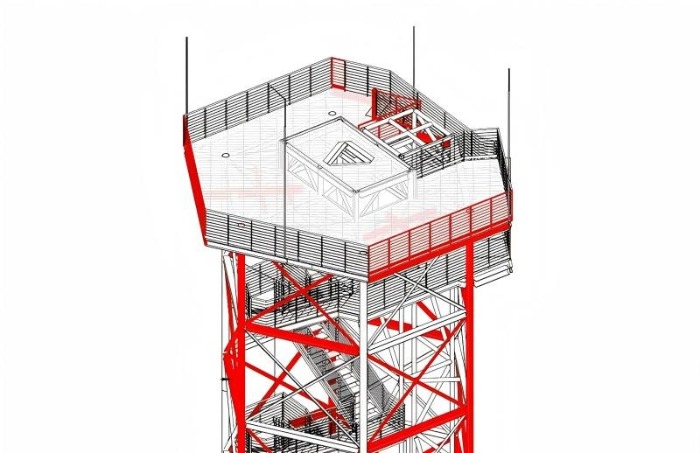
· Walkway Clearance: The platform footprint must allow maintenance personnel to safely navigate around the entire perimeter of the radome or antenna without obstruction, typically requiring 0.9 to 1.2 meters of clear walkway.
· Live Load Capacity: Platforms must be designed for a minimum concentrated live load of 250 lbs (113 kg) at any point on horizontal members, and up to 500 lbs (227 kg) at mount pipe locations, per ANSI/TIA-222-H.
· Safety Railings: Perimeter guardrails must be 42 inches (1.07 m) high, featuring a mid-rail with openings no greater than 19 inches (48 cm), to comply with OSHA fall protection standards.
· Equipment Handling: The platform must accommodate hoisting mechanisms, cable drop holes, and sufficient open space for temporary staging of heavy radar components (like servo motors or waveguides).
· Rigid Diaphragm: The maintenance deck itself is often constructed of open steel grating and heavily cross-braced to prevent local flexing, which would degrade the radar's pointing accuracy.
The primary function of the radar platform is to provide a safe, unobstructed working environment for technicians. Radar systems require routine calibration, preventive maintenance, and emergency repairs at the antenna level.
According to general radar station design principles (such as GB 51418), the platform dimensions must ensure that maintenance personnel can safely walk and operate outside the radome. If the platform is too tight, technicians cannot safely maneuver around the antenna, especially when wearing fall protection harnesses or carrying tools.
Key Spatial Requirements:
· Perimeter Walkway: A continuous clear walkway around the radome or antenna is mandatory. In practice, this requires a clear width of 0.9 to 1.2 meters (approximately 3 to 4 feet).
· Hatch and Ladder Access: The access hatch from the ladder to the platform must be large enough for a fully equipped technician. Standard practice for radar rooms and hatches requires minimum dimensions of 1m x 1m to allow for safe passage.
· Headroom: If the platform is partially enclosed or located beneath the radome base, sufficient headroom (typically at least 2 meters) must be maintained to prevent tripping and allow for the safe use of tools.
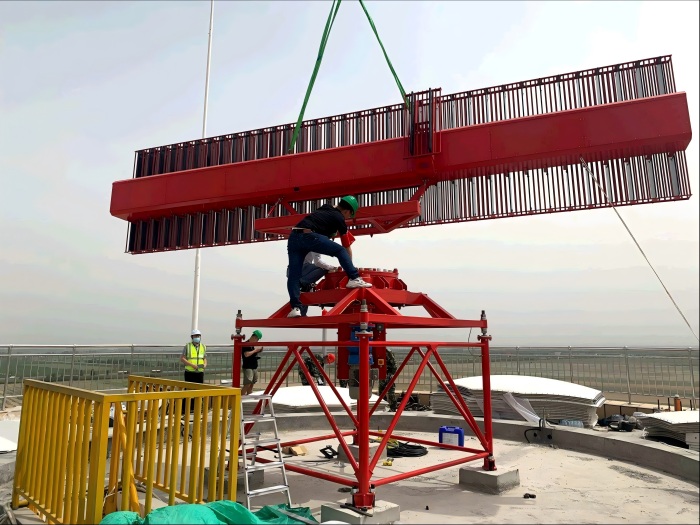
A radar platform is not just a walkway; it is a construction and maintenance site suspended in the air. Technicians need space to stage tools, handle heavy components, and operate hoisting equipment.
· Tool and Spare Parts Staging: Maintenance requires space for toolboxes, diagnostic equipment, and replacement parts (e.g., servo motors, waveguide sections). The platform must have dedicated areas where these items can be securely placed without creating a tripping hazard.
· Hoisting and Rigging: Platforms usually feature a davit crane or a hoist mounting point. The platform layout must ensure that lifting paths are clear and that hoisted equipment can be swung onto the deck without striking the guardrails or antenna structure.
· Cable and Waveguide Routing: Radar systems use thick, rigid waveguides and heavy RF cables. The platform must feature dedicated cable drop-outs and routing trays. Waveguides must be securely anchored to the platform structure and routed so they do not intrude into the personnel walkway.
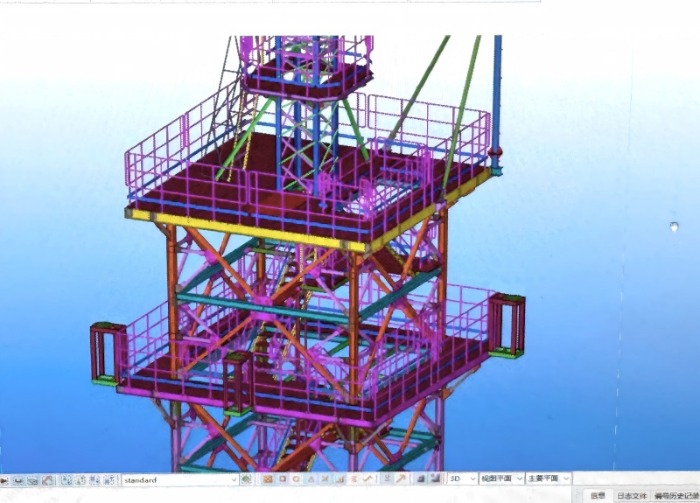
The floor of the radar platform must be engineered to withstand the dynamic weight of personnel, tools, and equipment. In the United States, this is governed by ANSI/TIA-222-H (Structural Standard for Antenna Supporting Structures).
TIA-222-H specifies rigorous live loading conditions for platform design:
· Concentrated Loads: A platform must be analyzed for a 250-lb (113 kg) live load applied individually at the midpoint and cantilevered ends of horizontal members.
· Mount Pipe Loads: At the locations of antenna mount pipes, the platform must withstand a 500-lb (227 kg) live load.
· Uniform Loads: While concentrated loads often govern local member sizing, the overall platform deck must also support a uniform live load (often 200 kg/m² or more) to account for multiple technicians and their equipment.
Because the platform is elevated, wind loads on personnel and temporary equipment during maintenance must also be considered in the structural analysis.
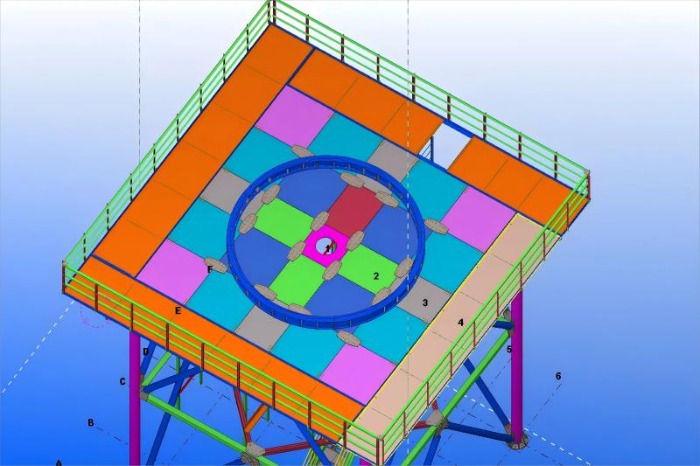
Safety is the overriding concern on a radar platform, but the safety systems must not compromise the tower's structural stiffness.
· Guardrail Heights: According to OSHA 29 CFR 1910.29 and 1926.502, the top edge of guardrails must be 42 inches (1.07 m) ± 3 inches above the walking surface. Mid-rails must be installed so that openings are no greater than 19 inches (48 cm).
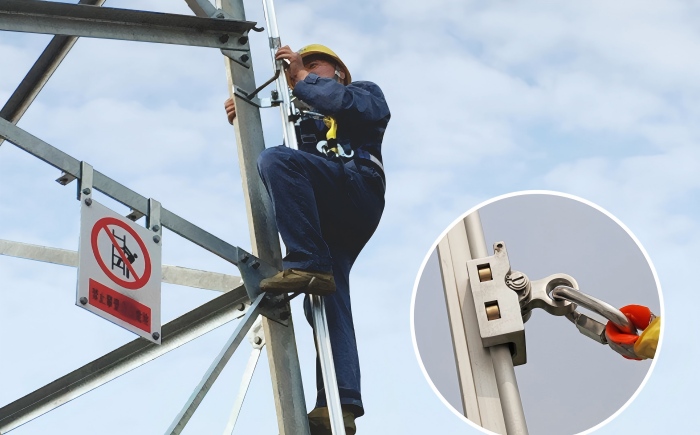
· Fall Arrest Systems: Platforms must include anchor points for personal fall arrest systems. A continuous vertical lifeline or rigid rail system is often integrated into the ladder and platform access point.
· The Stiffness Constraint: The platform must be designed as a rigid diaphragm. This means the floor beams and bracing must be stiff enough to distribute the concentrated loads of the radar pedestal across the tower legs. If the platform is too flexible, it will lower the natural frequency of the entire tower, potentially causing resonant vibration with the rotating radar antenna.
When designing and fabricating a radar tower platform, theoretical calculations must be translated into physical steel with sub-millimeter precision. Altai Tower integrates advanced engineering and manufacturing processes to ensure that the maintenance space is both safe and structurally optimized.
How Altai Tower Executes Platform Design:
· Custom Sizing: Our engineering team uses advanced design software (including SAP2000 and MS Tower) to model the platform as a rigid diaphragm. We customize the platform diameter to provide the exact walkway clearance required by the specific radar OEM, ensuring technicians have safe access without adding unnecessary dead weight.
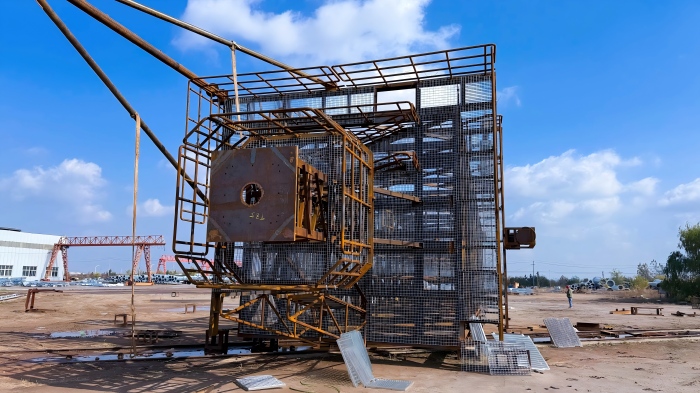
· Precision CNC Fabrication: The mounting interface for the radar pedestal must be flawless. Altai Tower utilizes CNC drilling to ensure that the bolt holes on the platform match the radar base flange perfectly, avoiding the need for hazardous field modifications.
· Safe Access Integration: Our platforms feature heavy-duty open steel grating for slip resistance and wind load reduction. We integrate OSHA-compliant 42-inch guardrails and dedicated fall-arrest cable brackets directly into the platform framing.
· Hot-Dip Galvanizing: The entire platform structure undergoes hot-dip galvanizing (ASTM A123), ensuring that the safety-critical walkways, guardrails, and grating will not corrode or weaken over decades of exposure.
Q1: Can maintenance personnel work on the platform while the radar is rotating?
A: In most ATC and weather radar systems, the radar must be completely stopped and locked out/tagged out before personnel are permitted to access the platform near the antenna. The rotating antenna creates a severe hazard. The platform layout must include a "safe zone" away from the antenna sweep radius for technicians to stage equipment.
Q2: Why is open steel grating preferred over solid steel plate for the platform?
A: Open grating is preferred for three reasons: it sheds rain and ice quickly, reducing slip hazards; it reduces the wind load on the platform (allowing wind to pass through); and it allows inspectors to visually check the condition of the structural members and bolted connections below the deck.
Q3: What is the difference between a 250-lb and 500-lb live load in TIA-222?
A: The 250-lb (113 kg) load represents the weight of a single maintenance worker applied to the middle or end of a structural floor beam. The 500-lb (227 kg) load represents the heavier concentrated force applied at specific mounting pipes where antennas or equipment are attached to the platform.
Q4: How does Altai Tower handle the shipping of large radar platforms?
A: Radar platforms can be quite large (e.g., 4 to 6 meters in diameter). To optimize shipping costs, Altai Tower designs the platforms in modular sections. The sections are bolted together on-site using precision CNC-punched splice plates, ensuring the final assembled platform maintains its rigid diaphragm characteristics.
Q5: Does the platform need to support the weight of the radome?
A: In many ATC radar systems, the radome sits on a separate structural ring beam or directly on the tower legs, independent of the maintenance platform. However, the platform must still be designed to resist the wind uplift and localized forces generated by the radome structure. Altai Tower engineers confirm the exact load path during the structural analysis phase.
Designing a radar tower platform is a meticulous balance of human safety, equipment access, and dynamic structural stiffness. The maintenance space must be generous enough for technicians to work safely and hoist heavy equipment, yet rigid enough to prevent vibration from degrading the radar's data.
At Altai Tower, we engineer and manufacture radar platforms that meet these exacting standards. From CNC precision drilling to ensure perfect pedestal alignment, to hot-dip galvanizing for 30+ years of corrosion protection, our manufacturing capabilities are built to support critical aviation and meteorological infrastructure.
Ready to optimize your radar tower design? Contact our engineering team today. Provide us with your radar OEM's technical specifications and site wind conditions, and we will deliver a complete structural design and fabrication proposal.



 IPv6 network supported